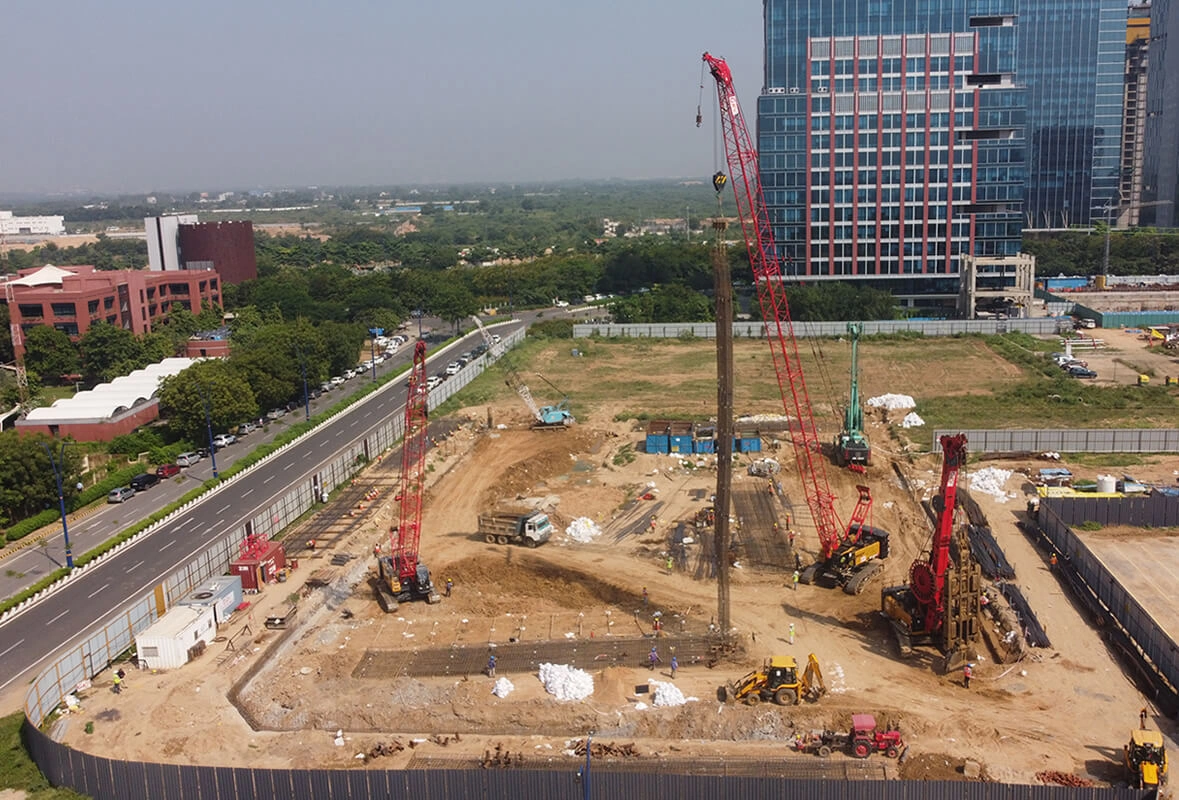
Challenging conditions are common in urban construction projects. Finding construction space, neighboring buildings, traffic, utilities, and the high depth of excavation can pose challenges for traditional construction approaches. Under these conditions, diaphragm walls are an effective and secure solution for providing stable excavation areas and safeguarding adjacent structures.
Diaphragm walls are generally used in basements, metro stations, Underground parking, tunnels, foundations and other large-scale infrastructure projects. They offer structural support and retain the soil, are helpful, especially when excavations are near to buildings or roads.
There is not a lot of space available for construction activities in urban areas. If a deep excavation is occurring near an existing building, there may be some ground movement that can impact the foundation associated with the building. It may be necessary to use open-cut machines with wide slopes, so that this may also need more land.
The D Wall construction is the technology used to form deep excavations while causing minimal disruption to the surrounding soil. They have high stiffness, which controls soil movements and supports the sides of the excavation.
They are particularly useful if a project is near roads, buildings, railway lines, utilities & other building structures.
Typically, the construction process starts with site preparation and drawing the alignment of the walls. Then the correct position of the panels is maintained by the construction of guide walls, which also support the upper part of the trench.
The excavation equipment is used to dig the trench to the required depth. In excavation, bentonite or other appropriate slurry can be used to stabilize trenches.
Diaphragm wall grabs are commonly used to excavate individual panels with the required width and depth.
Once the desired depth is reached, the trench is cleaned and the reinforcement cage is placed in this place. The concrete is poured from the bottom up by using tremie pipes. This process is used to produce a continuous reinforced concrete panel.
Panels are built next to each other in the desired sequence until the desired wall length is reached.
A diaphragm wall’s primary role is to keep soil in place when working in deep excavations. The wall is able to take lateral earth pressure and contributes to stabilization of the working face.
This is particularly important for underground structures where excavation may extend several metres below ground level.
The soil will possibly move and settle around the construction area during excavation. In urban area, even slight structural movement may impact nearby structures.
Diaphragm wall is a stiffer retaining system, which can effectively reduce the ground movement under the appropriate design, construction and support conditions.
Another use of the diaphragm walls is to minimize movement of groundwater into an excavation. The use of appropriate joints and quality of concrete can make them effective underground barriers.
This may be helpful for projects, which require some groundwater control, such as the construction of a basement, underground stations, tunnels, etc.
In several projects, after excavation the diaphragm wall is not removed. Instead, it becomes part of the permanent structural system. It can be used as a wall for a basement or as support for the underground part of the structure of a building.
Professional diaphragm wall services cover important activities involved in constructing underground retaining walls. This can include site assessment, excavation planning, panel excavation, slurry management, reinforcement installation, concrete placement, quality control and monitoring on site.
Proper planning is important because urban sites often have limited access and existing structures nearby. Experienced contractors can select suitable construction methods and equipment according to the project conditions.
One of the primary benefits of diaphragm walls is that they can support deep excavations in limited space. They are stiff which can control lateral ground movement and reduce the potential effect on adjacent structures.
They can also built to a great depth, which is appropriate for projects that require a deeper retaining system than a shallow retaining system.
The advantage is that they can use as a temporary retaining wall and permanent structure. This can save additional labour required for wall construction.
When proper construction techniques and joint treatments are used, diaphragm walls can be used successfully in high groundwater conditions.
It plays a significant role for the deep and narrow panels in the excavation. diaphragm wall grab machine is used to operate the grab, and to give lifting and positioning capability to remove soil from the trench.
Modern machines have the ability to offer better control of the excavation while they may also be set up with verticality and depth control. The right machine must be chosen based on panel size(s), soil types, site constraints, and project needs, as well as the depth of excavation.
In urban construction, some factors to consider are maneuverability and space requirements, as machinery can be required to work near existing buildings.
GKV Infrastructure focuses on diaphragm wall construction equipment and solutions for demanding underground construction requirements. The company have a specialized equipment and works with modern construction approaches to support projects where excavation accuracy, productivity, and operational control are important.
Choosing the right equipment partner is important because every diaphragm wall project has different soil conditions, excavation depths, panel dimensions, and site restrictions. GKV Infrastructure has experience in diaphragm wall-related construction equipment and provides solutions intended for deep excavation and infrastructure projects.
Diaphragm wall is an important part in the current construction of urban buildings. They allow to perform deep excavation without any problem when there is not enough space to install work equipment.
A diaphragm wall can be used for earth support, control of groundwater, and/or retention of earths in the basement, in tunnels and major infrastructure projects.
In the future, the needs for reliable solutions to deep excavation will continue to be a strong market demand, as cities further develop their subterranean assets. Diaphragm wall projects can be performed with better control, security and efficiency when managed using the right construction strategy and equipment partner.
The main functions of a diaphragm wall are to support deep excavations & prevent the adjacent soil from spreading away. It can also be used as a groundwater cut-off and as a permanent structure depending on the project.
These can be temporary or permanent. They are used in many underground projects as part of the final project and are used as basement or retaining wall.
Narrow and deep panels in the ground can be excavated by using a diaphragm wall grab. They extract soil strategically in programmed cycles, while controlling the size of the panels.
They are often used for deep basements, metro, or underground parking, tunnels, pumping stations, high-rise buildings & other large-scale infrastructure projects.
They can be used in congested areas and offer deep excavation support without the need for large sloped excavation areas. They can also be placed near an existing building if planned and constructed appropriately.

We’re here to assist you and answer any questions you may have. Submit this form to send us your Inquiry.
You can also call us at +91 97272 54900.

 Get in Touch


